
Dancing out of season: a tale from the edge of habitability.
In Tamil Nadu, farmers say: when the peacock dances out of season, the crops are already ghosts. An essay on reading the atmosphere’s oldest warning system.
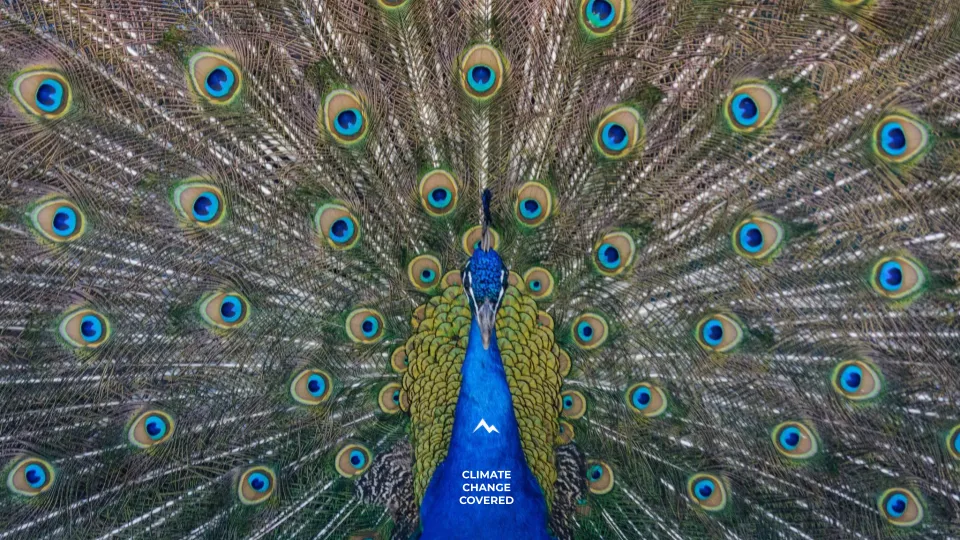
In the hours before the monsoon fails, the peacocks know. They gather in the mango groves with their impossible plumage dragging through dust that should already be mud, their calls rising in pitch until the sound becomes less like birdsong and more like warning sirens wrapped in feathers.
The villagers have learned to read these congregations, these parliament of iridescent prophets who strut through the changed world trailing their ornate tails like nature’s own seismographs, sensitive to tremors in the atmospheric order that human instruments only capture as data points, as graphs trending upward into catastrophe.
The peacock’s eye-spots—those azure and emerald circles that evolved to mesmerize predators and seduce mates—have become something else entirely in this era of atmospheric unraveling. Now they seem less like eyes and more like targets, or perhaps like the circular patterns that form on weather radar just before a system intensifies beyond prediction.
Each ocellus a tiny mirror reflecting not vanity but emergency, each iridescent feather a spectrum-splitting reminder that beauty and apocalypse have always shared closer quarters than we care to admit. When the males fan their trains in the copper light of what used to be winter, what was once courtship display now reads as semaphore, as desperate signaling from the edge of habitability.
They appear first at the peripheries, these birds. At the boundaries where forest meets settlement, where the old climate touched the new. Farmers report them stalking through failed rice paddies, their metallic blue necks bobbing among the withered stalks like periscopes surveying wreckage. They colonize the cracked beds of reservoirs, scratching at earth that hasn’t seen water in months, their tracks forming mandalas in the silt—circular, obsessive, ritualistic.
There is something deeply unsettling about their presence in these new geographies. Peacocks multiplying in drought-stricken regions where they were once rare. Peacocks haunting the margins of megacities, their cries echoing between concrete towers on nights when the heat refuses to break, when the air itself feels solid with warmth and particulate matter. They have become urban birds now, climate refugees in reverse—not fleeing the disaster but arriving just before it, like heralds sent ahead by some ministry of atmospheric collapse that operates on frequencies humans cannot parse.
Children in Delhi balconies report them perched on air conditioning units, their trains hanging down like ancient tapestries over machinery designed to make air breathable. The symbolism is so heavy it borders on satire.
The ornithologists mention range expansion, habitat disruption, the cascading effects of temperature anomalies on territorial behavior. They show maps with colored zones creeping northward, animated GIFs of migration patterns shifting like continents in fast-forward. But even the scientists, in their more unguarded moments, admit to the eerie precision of it—the way peacock sightings cluster around regions that will, within months, experience unprecedented flooding, unprecedented drought, unprecedented fire. As if the birds can taste disaster in the air, as if their baroque nervous systems are tuned to detect the specific frequency at which normal weather curdles into calamity.
In Tamil Nadu, there is a saying among the farmers: “When the peacock dances out of season, the crops are already ghosts”. The elders remember when the birds danced only with the first rains, when their courtship was calibrated to monsoon’s reliable arrival. Now they perform their ritual displays in February, in October, in months that have no name for this kind of moisture or heat. They dance in confusion or perhaps in mourning, their fans opening like distress signals against skies that have forgotten their cues.
The young birds seem particularly agitated, their calls fragmented, their movements jerky. They pace the boundaries of agricultural land as if searching for something that used to be there—some atmospheric condition, some barometric signature that has been edited out of the air.
The tail feathers themselves have become artifacts of study, their microstructure revealing secrets about environmental stress. Scientists slice them into cross-sections, examine them under electron microscopes, and find encoded in the keratin a record of the seasons through which they grew. Feathers from peacocks in stable climates show regular, predictable patterns. But the feathers from birds living on the knife-edge of climate zones—those harbingers stalking the margins—display irregularities, malformations, stress markers that suggest the birds are metabolizing the chaos around them, incorporating environmental breakdown into the very architecture of their beauty.
And perhaps this is the cruelest poetry: that nature should choose its most ostentatious creation as the messenger of its unraveling. Not the sparrow, not the crow—birds already associated with omens and scavenging and the aftermath of human error. No, the peacock, that pinnacle of decorative excess, that bird whose entire evolutionary strategy is predicated on beauty so extreme it borders on dysfunction. Their tails are too heavy, too visible, too metabolically expensive to be anything but a luxury item, a signal of surplus and abundance. Except now that abundance is draining away, and the birds carry their luxury into diminishment like refugees clutching family jewels through the burning streets of a fallen capital.
In mythology, peacocks were companions to gods, vehicles for deities who controlled rain and thunder. Kartikeya rode a peacock into battle. Saraswati kept one at her side as the embodiment of wisdom and artistic truth. But those were stories from a stable Holocene, from ten thousand years of relatively predictable climate in which human civilization could take root and elaborate itself into pantheons and agriculture and cities. The gods of that era knew when the rains would come. The peacocks in their employ were ornamental, symbolic, saturated with meaning but not with warning.
These new peacocks—these Anthropocene peacocks—serve different masters. They are no longer emblems of prosperity but indices of its failure. They gather at the edges of dried lakes, their reflections missing from water that isn’t there. They call from the rooftops during heat waves that kill the elderly and the poor in their sleep. They appear in places they have no business being, following the invisible contours of atmospheric breakdown, tracking the slow-motion avalanche of climate feedback loops as they accelerate beyond tipping points into cascades.
And we, who receive these warnings, do precisely what humans have always done with prophecy: we record it, we document it, we turn it into data and papers and conference presentations. We note the correlation between peacock migrations and extreme weather events. We publish studies with titles like “Pavo cristatus Range Expansion as a Bioindicator of Regional Climate Instability.” We photograph them, frame them against backdrops of disaster—peacocks on scorched earth, peacocks in flooded streets, peacocks silhouetted against smoke from fires that burn for months. Their beauty makes for arresting images, viral content, the kind of visual that briefly penetrates the numbness before being scrolled past, replaced by the next beautiful catastrophe.
The peacocks themselves remain indifferent to our interpretations. They continue their strange migrations, their off-schedule displays, their colonization of marginal zones. They scratch at the hardening earth and call into air that tastes increasingly of transition, of systems approaching their breaking points. Whether they experience anything like dread or foreboding is unknowable. Perhaps they simply follow gradients we cannot perceive, chemical signatures in the wind, temperature differentials too subtle for our instruments. Perhaps their presence in these doomed places is mere coincidence, correlation mistaken for causation by a species desperate to find pattern in chaos, meaning in collapse.
But the coincidences accumulate. The sightings multiply. And in the villages and cities where peacocks now appear like gaudy ghosts of a more abundant past, people look up when they hear that cry—that strangled, almost human sound of alarm—and they know, even if they don’t say it, even if they dismiss it as superstition, they know: something is coming. The birds have announced it with their presence, with their impossible beauty dragged through the dust of our heating world, with their eyes that see what we refuse to, with their calls that translate the language of atmospheric catastrophe into something almost like song.
The monsoon will fail, or it will arrive with violence. The river will dry, or it will destroy the bridge. The heat will break records, or the cold will come where it shouldn’t. The peacocks have already told us. We need only to learn how to listen.
Originally published on LinkedIn.
